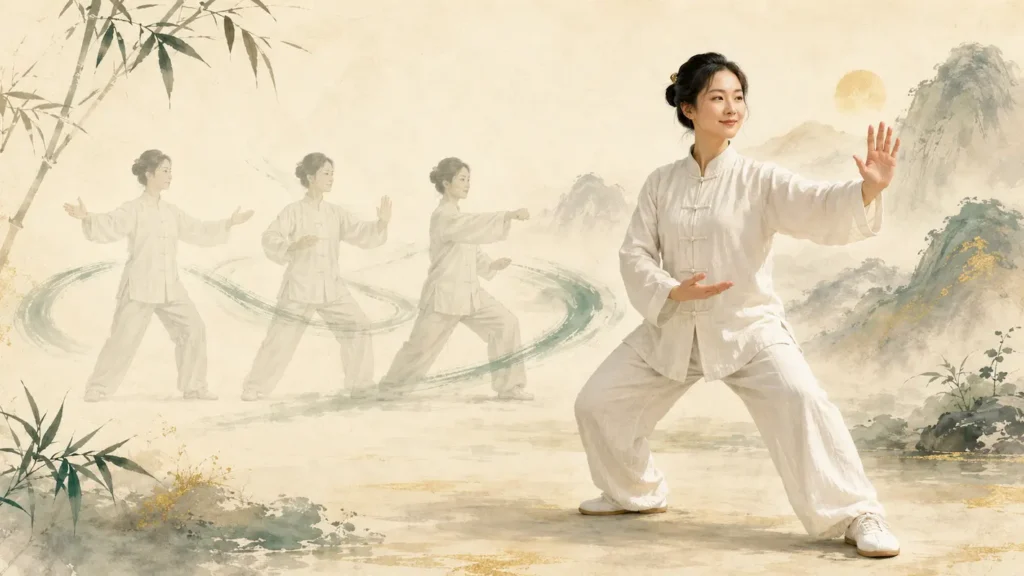
Tai Chi movements are slow, coordinated actions that combine posture, weight transfer, relaxed breathing and focused attention. Individual movements—such as Ward Off, Brush Knee and Cloud Hands—are linked into a continuous sequence called a form. Beginners do not need to memorize a long form immediately: learning how to stand, shift weight and move with control is the real foundation.
What are the main movements in Tai Chi?
Common beginner Tai Chi movements include Commencement, Ward Off, Roll Back, Press, Push, Single Whip, Cloud Hands, Brush Knee and Push, White Crane Spreads Its Wings, Repulse Monkey and Closing. Names and sequences vary by style and school, but the underlying skills remain similar: upright alignment, relaxed joints, clear weight transfer, coordinated whole-body movement and calm attention.
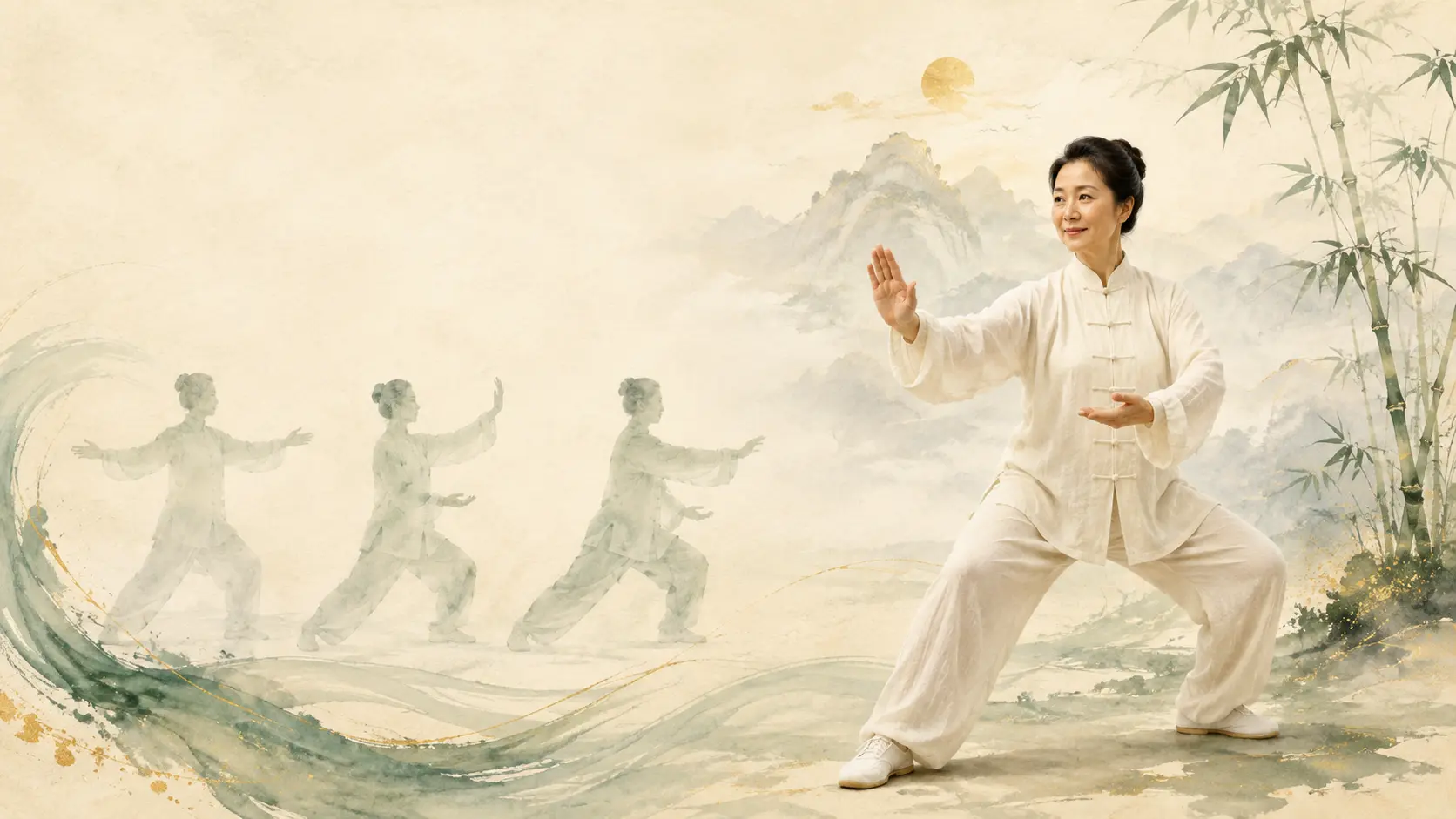
Movement, posture and form: what is the difference?
These terms are often used interchangeably online, but they describe different layers of practice:
- Posture: a recognizable body position or moment within a movement, such as the finishing shape of White Crane Spreads Its Wings.
- Movement: the complete transition from one position to another, including the shift of weight, turn of the waist and path of the hands.
- Form: a memorized sequence of connected movements practised as one continuous routine.
- Style: a broader tradition—such as Chen, Yang, Wu/Hao, Wu or Sun—with its own characteristic training methods and forms.
The visible hand shape is only one part of a Tai Chi movement. The more important question is what the whole body is doing: Where is the weight? Is the spine comfortably upright? Are the knees tracking with the feet? Does the waist lead the arms? Can the movement remain unhurried and continuous?
The core principles behind every Tai Chi movement
Different lineages use different language, yet several principles repeatedly appear across traditional instruction. Yang Chengfu’s widely taught “Ten Essentials,” for example, emphasize uprightness, relaxation, distinguishing substantial from insubstantial, coordinating upper and lower body, and continuity.
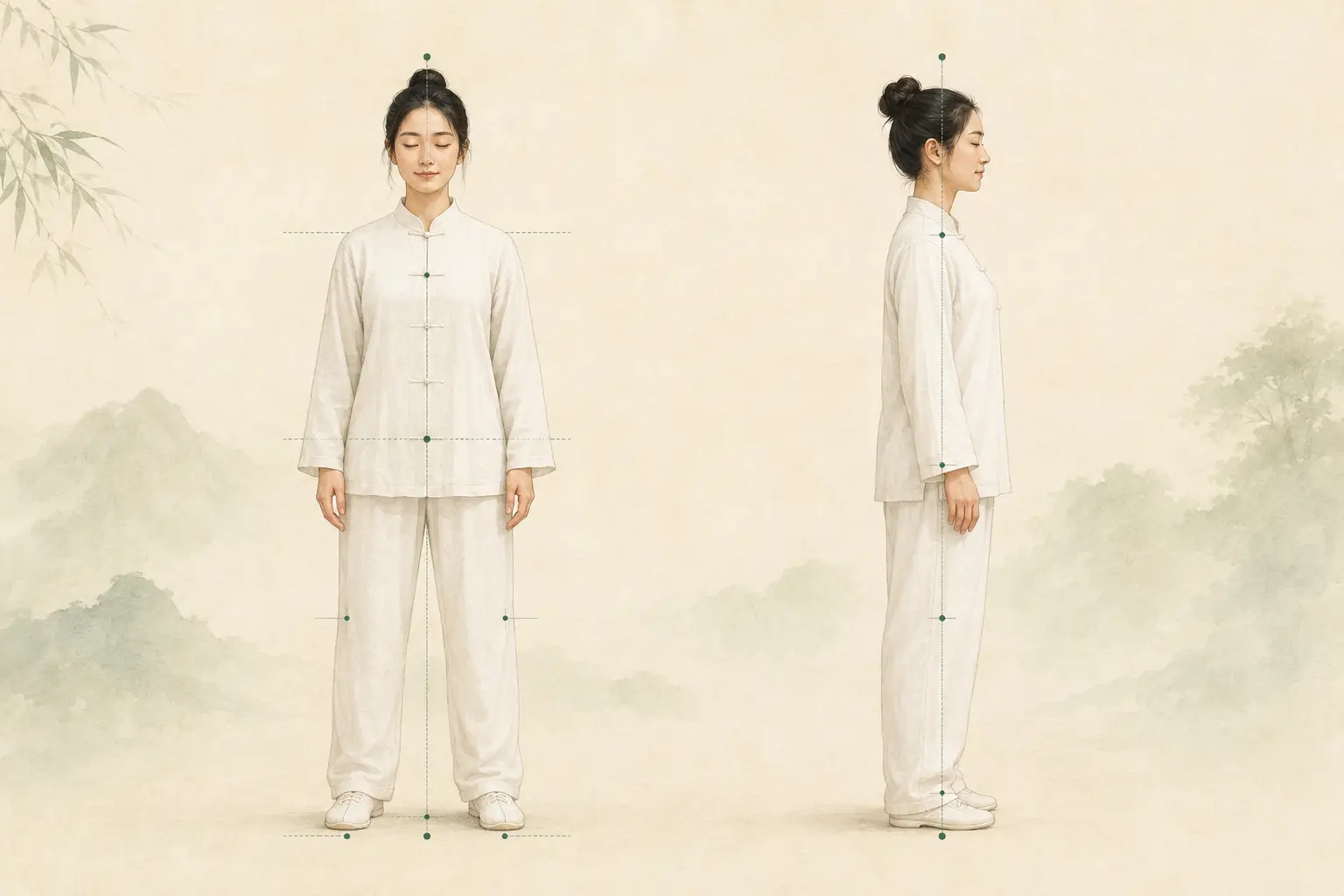
1. Comfortable upright alignment
Imagine the crown of the head gently rising while the shoulders and ribs settle. Avoid military stiffness, an exaggerated tucked pelvis or a collapsed chest. The aim is a balanced, alert structure that can move freely.
2. Relaxation without collapse
In Tai Chi, relaxation does not mean becoming limp. Release unnecessary tension while retaining enough muscular support to organize the joints. Hands remain alive but not clenched; elbows feel heavy; knees stay responsive rather than locked.
3. Clear weight transfer
Before a foot steps, the supporting leg receives the weight. Before the body turns, you know which leg is “full” and which is “empty.” This separation improves clarity and makes stepping more controlled.
4. Whole-body coordination
The arms should not perform an isolated choreography. The feet establish contact, the legs support and shift, the pelvis and torso guide direction, and the hands express the resulting movement. Beginners can think: feet, legs, centre, hands.
5. Continuity and calm attention
Movements flow without abrupt stops, even when one named posture becomes the next. Breathing stays natural and attention remains on the quality of movement rather than rushing to finish the sequence.
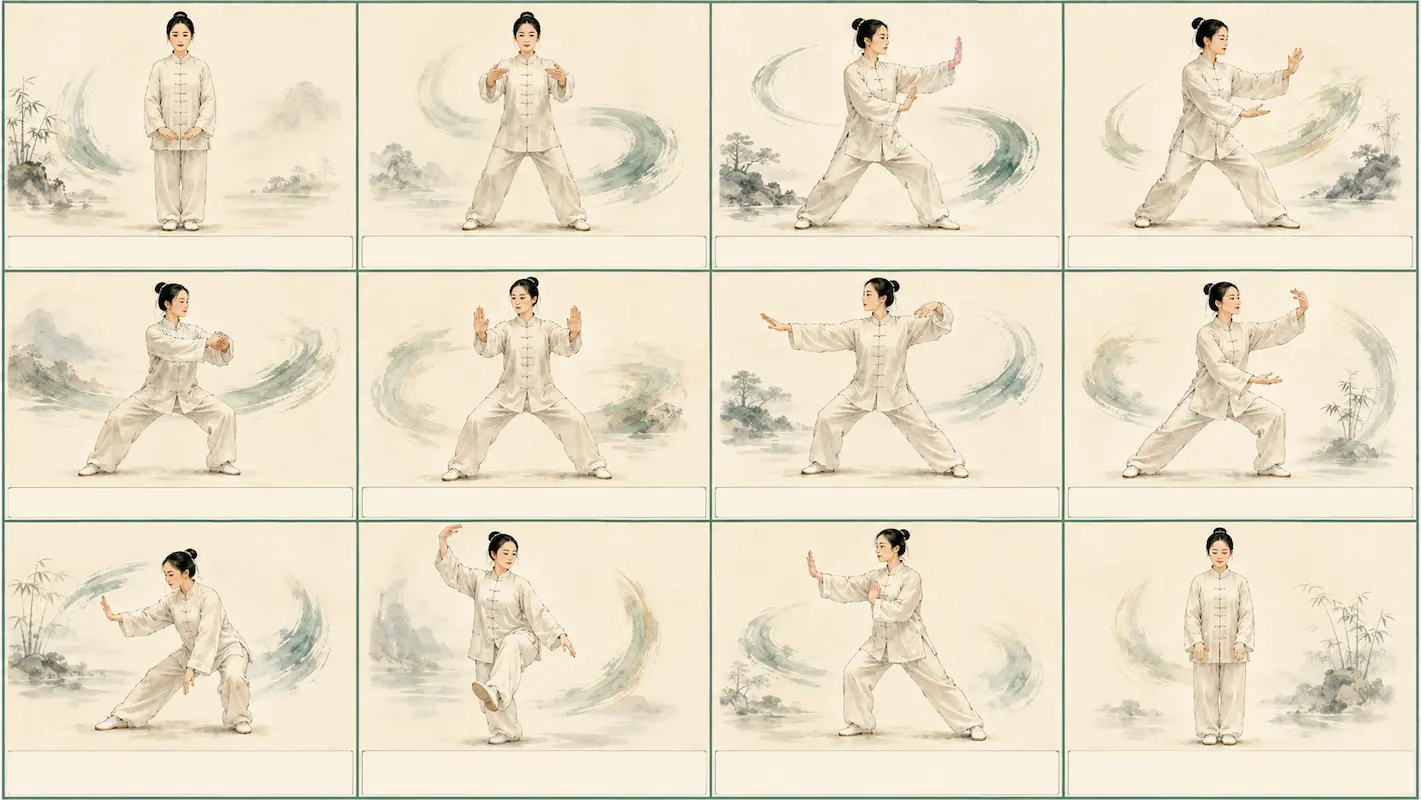
12 essential Tai Chi movements beginners should know
There is no single universal list, because names, translations and choreography differ among forms. The following movements are especially useful because they introduce recurring Tai Chi skills.
1. Wuji or preparation posture
Wuji is the quiet starting position: feet placed comfortably, knees softly unlocked, spine naturally upright and arms resting. It trains awareness before movement begins.
2. Commencement or opening
The arms float upward and settle as the knees soften. The movement introduces coordinated rising and sinking without lifting the shoulders.
3. Ward Off
One arm forms a rounded supporting shape while the body settles into a stable stance. Ward Off develops expansion, structure and whole-body connection without rigid force.
4. Roll Back
The torso turns as the weight shifts, guiding the hands along a curved pathway. Practise turning from the centre instead of pulling with the arms.
5. Press
The hands coordinate with a forward weight shift. Keep the chest easy and avoid leaning past the supporting base.
6. Push
The palms draw back and move forward as the legs receive and return the body weight. The hands finish without locking the elbows.
7. Single Whip
This expansive posture uses a wide stance, one open palm and a hooked hand in many Yang-style forms. It teaches lateral awareness and coordinated opening.
8. Cloud Hands
The hands circle while the body shifts sideways and the waist turns. Cloud Hands is excellent for learning continuous coordination, but the knees should follow the direction of the toes rather than twisting inward.
9. Brush Knee and Push
One hand passes near the knee as the other presses forward. The movement combines stepping, torso rotation and opposing hand paths.
10. White Crane Spreads Its Wings
One hand rises while the other settles, often with the front foot lightly placed. The posture develops vertical separation and balance between upward and downward intent.
11. Repulse Monkey
This backward-stepping movement coordinates one retreating step with a forward palm. Beginners should shorten the step, confirm the floor is clear and prioritize balance over range.
12. Closing
The arms settle and the stance returns toward stillness. Closing is not merely an ending; it is an opportunity to notice breathing, posture and the effect of practice.
Beginner tip: Learn the pathway at a small, comfortable range first. A smaller movement with clear balance is more valuable than a dramatic shape created through strain.
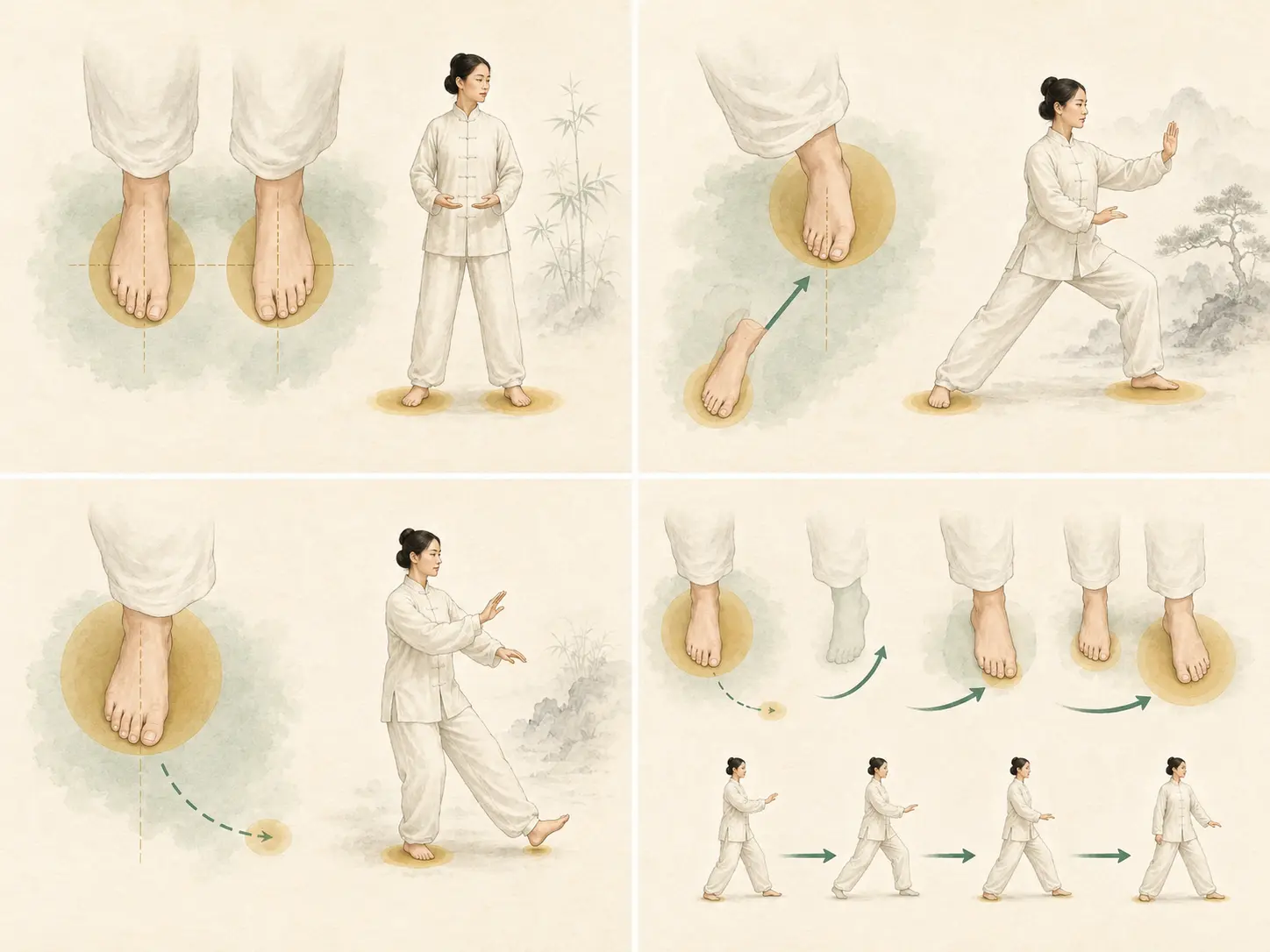
Tai Chi stances, stepping and weight transfer
Hands attract attention, but footwork organizes the movement. A beginner who understands weight transfer will usually progress more safely than someone who memorizes arm patterns alone.
Parallel or Wuji stance
A neutral standing base used for preparation, alignment and quiet practice. Foot width varies by school and individual comfort.
Bow stance
One foot is forward and the other supports behind, with weight distributed according to the movement and lineage. The stance should feel stable, not stretched to its maximum. The front knee generally follows the direction of the toes.
Empty stance
Most weight remains in the rear leg while the front heel or toe touches lightly. This stance appears in movements such as White Crane and Hand Strums the Lute.
Horse stance
A wider, centred stance used in different ways across styles. Beginners should avoid forcing depth; comfort, alignment and the ability to breathe freely matter more than sitting low.
Tai Chi stepping
- Settle over the supporting leg without leaning.
- Release the other foot so it becomes light.
- Place the heel or toe gently, according to the step.
- Confirm balance and knee-foot alignment.
- Transfer weight gradually.
- Let the rear foot adjust only when the movement calls for it.
This controlled sequence distinguishes Tai Chi stepping from simply walking slowly. It trains awareness of when the body is supported and when a foot is free to move.
Major Tai Chi styles and forms
A form may contain a handful of movements or more than one hundred named postures, depending on how the sequence is counted. Short forms are not automatically superficial, and long forms are not automatically better. The best form is one you can practise consistently with sound instruction.
Yang style
Yang-style practice is commonly associated with spacious, even and flowing movements. Short Yang-style sequences are widely used for beginner and wellness-oriented instruction, while traditional schools also preserve longer forms.
Chen style
Chen forms may combine slow, coiling movement with changes of tempo, lower positions and explosive expressions of power. Training intensity varies greatly, and beginner adaptations are possible.
Wu/Hao style
Wu/Hao is known for a compact frame and subtle internal organization. It is distinct from the Wu style associated with Wu Jianquan.
Wu style
Wu-style forms often use a smaller frame and characteristic body inclinations while maintaining integrated alignment. As with every style, appearance should be understood through qualified instruction rather than copied from a still image.
Sun style
Sun style is recognized for agile stepping, upright positions and “follow steps,” with influences from other Chinese internal martial arts. Adapted Sun-style programs are also used in community health settings.
Common form lengths
- 8- or 10-movement forms: accessible introductions that teach core patterns in a compact practice.
- 16-movement forms: a bridge between introductory and longer sequences.
- 24-form: a standardized simplified form developed in China and practised internationally.
- Traditional long forms: lineage-specific sequences with more repetitions, transitions and technical depth.
- Specialized forms: sword, sabre, fan and partner forms, usually learned after foundational empty-hand practice.
| Form type | Useful for | Typical challenge |
|---|---|---|
| 8–10 movements | First-time learners and short daily practice | Learning principles rather than merely copying shapes |
| 16 movements | Building transitions and directional awareness | Remembering a longer sequence |
| 24-form | A recognized standardized routine | More choreography and stance changes |
| Traditional long form | Deep, sustained study within a lineage | Time, memory and access to detailed feedback |
How should a beginner choose a Tai Chi form?
Choose the teacher and learning environment before choosing a famous form name. Look for instruction that explains alignment and weight transfer, offers modifications, welcomes questions and does not pressure students into painful positions.
A short Yang-style or appropriately adapted Sun-style sequence may be approachable for many beginners, but individual needs matter more than labels. Consider:
- your current balance, joint comfort and mobility;
- whether you prefer in-person correction or online self-paced learning;
- the time you can practise consistently;
- whether chair support or seated alternatives are required;
- whether your interest is wellness, cultural study, martial application or all three.
Try one coherent sequence for several weeks before collecting movements from unrelated videos. Repetition reveals details that novelty hides.
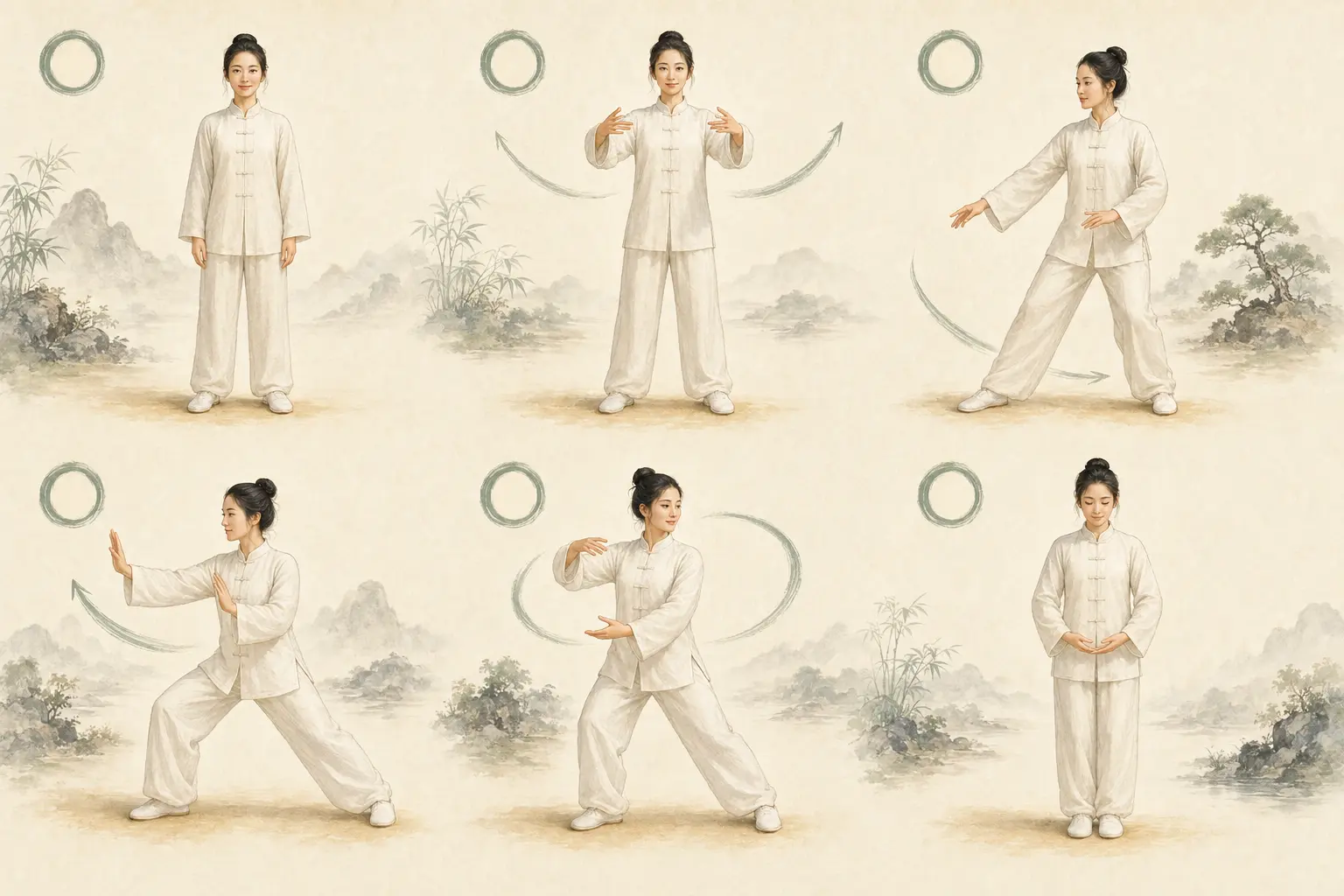
A simple 8-minute Tai Chi starter sequence
This is a gentle skill-building outline, not a substitute for individualized instruction. Use a stable floor, comfortable footwear or an appropriate barefoot surface, and keep a wall or sturdy chair nearby if balance is uncertain.
- Arrive in Wuji — 1 minute: notice your feet, soften the knees and let the breath remain easy.
- Opening — 1 minute: float the arms up and let them settle, repeating slowly.
- Side-to-side weight shifts — 2 minutes: move only as far as you can maintain an upright torso and comfortable knees.
- Ward Off shapes — 1 minute each side: form a rounded arm while the opposite hand rests near the waist.
- Small Cloud Hands — 2 minutes: shift and turn gently, keeping the feet planted at first.
- Closing — 1 minute: allow the hands to settle and return to quiet standing.
Practise three to five days per week if that feels manageable. Increase complexity only when the basic sequence feels steady and comfortable.
Seven common Tai Chi movement mistakes
- Copying the hands while ignoring the feet. Rebuild the movement from its weight shift.
- Stepping before the supporting leg is ready. Become stable first, then release the moving foot.
- Making stances too long or low. Reduce the range until alignment and breathing feel natural.
- Twisting the knee. Turn through the hip and adjust the foot rather than forcing rotation through a planted knee.
- Raising the shoulders. Let the elbows remain weighted and the neck easy.
- Holding the breath. Return to quiet natural breathing; precise breath choreography can come later.
- Rushing to learn more movements. Improve one transition before adding five new postures.
Can anyone practise Tai Chi movements safely?
Tai Chi is generally considered a safe practice, and the U.S. National Center for Complementary and Integrative Health notes that it may help balance and fall prevention in some populations. However, “gentle” does not mean risk-free or suitable in the same form for everyone.
Stop and seek appropriate advice if movement causes sharp pain, chest pain, faintness, unusual shortness of breath or new neurological symptoms. People recovering from surgery or injury, those with significant balance problems, and those managing cardiovascular, neurological or musculoskeletal conditions should ask a qualified healthcare professional what level of activity is appropriate.
Useful adaptations include:
- smaller steps and higher stances;
- keeping one or both hands near a stable support;
- practising weight shifts before stepping;
- removing backward steps;
- using chair-supported or seated versions;
- shorter sessions with rest as needed.
The World Health Organization recommends that older adults include varied activity emphasizing functional balance and strength, but Tai Chi should be viewed as one possible component of a broader activity plan—not a replacement for all aerobic, strengthening or medical care needs.
What does research say about practising Tai Chi?
Research summaries from NCCIH report encouraging evidence for balance and fall-related outcomes in older adults, while also noting that findings and certainty vary by condition and study. Recent systematic reviews have likewise reported improvements in static or dynamic balance among older adults. These results describe groups, not guaranteed outcomes for an individual.
Form names alone do not explain research outcomes. Program length, teaching quality, frequency, participant health, movement intensity and adherence all influence results. That is why evidence-informed guidance should say Tai Chi may support a goal when research is promising—not promise that a particular movement will cure or prevent a medical condition.
Frequently asked questions about Tai Chi movements and forms
How many movements are there in Tai Chi?
There is no single total. Different styles and forms divide and count movements differently. Introductory forms may contain 8–16 movements, the standardized 24-form contains 24 named sections, and traditional long forms may be counted as 85, 88, 103, 108 or another number depending on the lineage and counting method.
What is the easiest Tai Chi form for beginners?
A well-taught short form with comfortable stances is usually easier to begin than a long sequence. Many learners start with an 8-, 10- or 16-movement form. The quality of instruction and suitability of adaptations matter more than the form’s name.
Can I learn Tai Chi movements at home?
You can learn basic posture, weight shifting and a short sequence at home from clear instruction. Occasional feedback from a qualified teacher can help identify alignment or balance problems that are difficult to notice by yourself.
Should Tai Chi movements be synchronized with breathing?
Beginners should usually keep breathing natural, quiet and unforced. Some schools teach specific breathing coordination as training develops, but holding or forcing the breath is unnecessary for foundational practice.
Is Tai Chi a martial art or an exercise?
Tai Chi originated as a Chinese martial art and is also widely practised today for movement, mindfulness, culture and general wellness. Training goals and methods differ among schools.
How long does it take to learn a Tai Chi form?
A short sequence may be memorized in several weeks, while performing it with coordinated weight transfer, alignment and continuity takes ongoing practice. A traditional long form can take months or longer to learn and refine.
What should I learn after a beginner form?
Deepen the same form before immediately changing routines. Improve transitions, stepping, relaxation and directional clarity. Then consider a longer form, partner sensitivity work or weapons training with a suitable instructor.
Sources and further reading
- National Center for Complementary and Integrative Health: Tai Chi—What You Need To Know
- World Health Organization: Guidelines on physical activity and sedentary behaviour
- Cui et al. (2024): Tai Chi and balance performance in healthy older adults
- Bertolini et al. (2024): Effects of Tai Chi Chuan on older adults’ balance
- International Yang Family Tai Chi Chuan Association: The Ten Essentials